The British
The First Fleet
There was no Australia before the British Empire invented it.
It was on Saturday, January 26th, 1788 that the British ‘First Fleet’ came to Sydney Cove on the east coast of New Holland. On that day they founded the colony of New South Wales, which at that time covered the whole of the eastern half of the island. This date is today celebrated as Australia Day.
The Union flag was raised and the officers drank a toast to the success of the settlement.
With this simple ceremony, the British Empire brought an end to the immense historical process that had begun thousands of years earlier in which civilisation spread around the world. The lifestyle of the city, with its dense urban environment fed by domesticated cereals and animal husbandry, administered using written records, and with ever advancing scientific technology, was now present on all the Earth's inhabited continents.
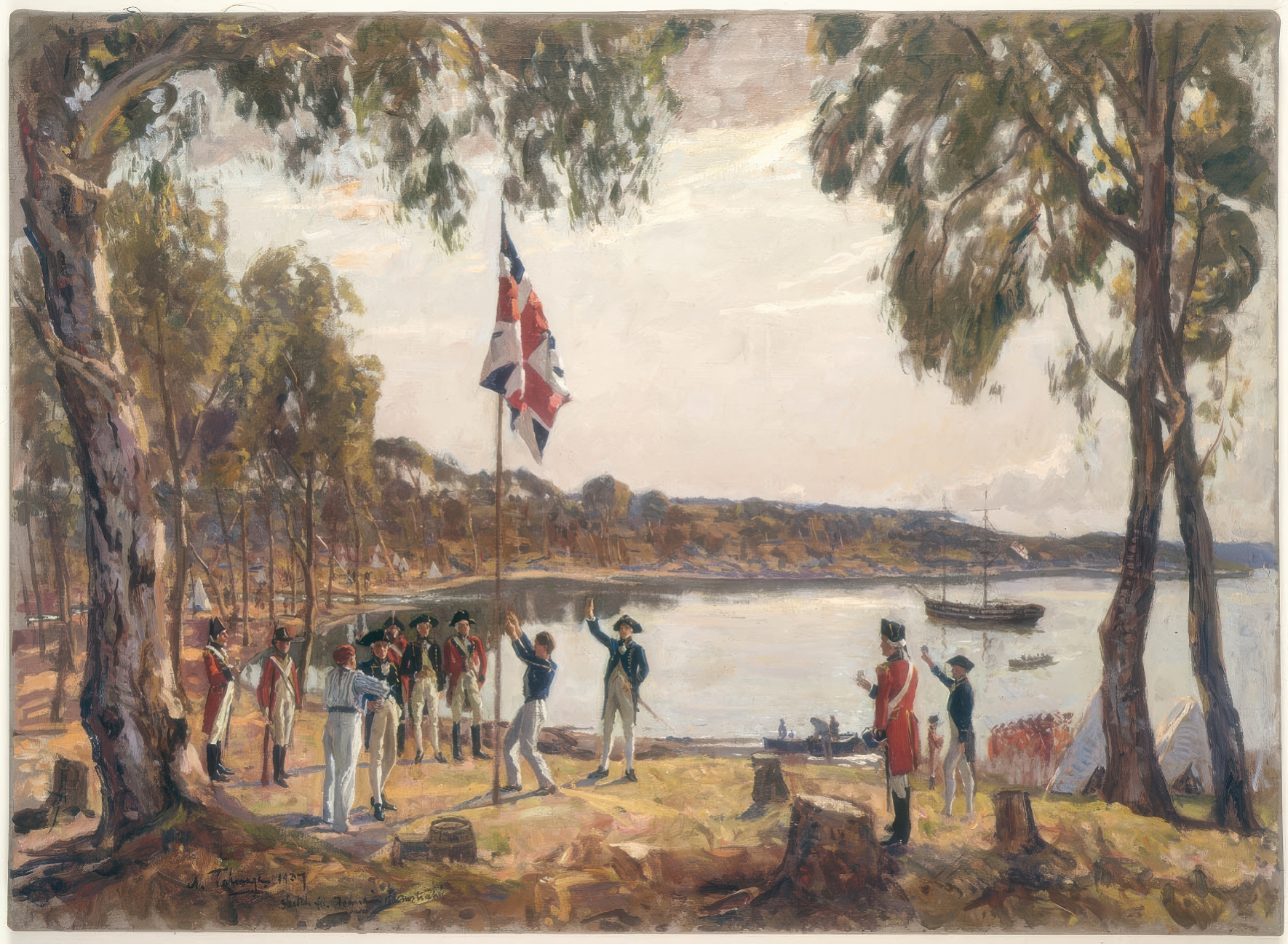
The Founding of Australia 1788
by Algernon Talmage, 1938
Western Australia
It was on June 1st, 1829 that the British Empire founded Western Australia on the west coast of New Holland. This date is celebrated as Western Australia Day.
From now on, the British-based society known as Australia would be fully synonymous with the island, a place which it also increasingly called Australia.
This had never been seen before. For the first time in history, a single sovereign was claiming possession of the entire continent.
Yet the claim was a strange one. The British colonies were divided not united, and the territory under settlement was tiny. Most of the island remained largely unexplored and was inhabited only by diverse and uncontacted Aboriginal tribes.
But in founding Western Australia, the British Empire introduced the concept of Unity into a land which hitherto had known only Division.
Queen Victoria
While it was under the authority of King George III that British settlement began in New Holland, it was Queen Victoria that most left her mark on Australia. She not only gave her name to two of the colonies (Victoria and Queensland), she gave her name to the entire era: the Victorian Age.
This was an age of incredible energy and dynamism. This was the age when the British Empire successfully industrialised and became the world's first global superpower. This was an age of remarkable scientific discoveries, incredible new technologies, and world-changing philosophies. And this was the age when the British monarchy adopted its current ceremonial role.
But for Australia — this was the age of consolidation, when British settlement gave birth to a new people, a new nationalism, and a new constitution. It was Queen Victoria who signed the Australian Constitution Act into Imperial law shortly before her death, unifying the six British colonies into one nation under her crown.
British Life
The British Empire was the product of thousands of years of history. Although the Australian society was young, through its mother country it gained access to cultures that were ancient.
The fruits of thousands of years of Jewish, Greek, Roman, Christian, and English cultures were transplanted wholesale by the British Empire onto an otherwise unrelated continent.
More contemporary British manners, morals, and customs likewise arrived with the colonists, becoming an inseparable part of Australian life.
Although Australia from the moment of its founding was a distinct society, its art, literature, and life would forever-after be based on the forms and types introduced by the Men of the West.
Pests
The British Empire introduced many plants and animals into Australia. While some, such as sheep and horses, were necessary for the development of the new society, others were not. These became pests.
Foxes and rabbits are the most iconic. The hunting of these creatures was a traditional sport in Great Britain, and for this purpose they were introduced into Australia. But once in Australia they spread beyond control.
Foxes hunted the native animals and preyed on livestock. Rabbits competed with the native animals for food, and lacking sufficient predators, their population exploded, becoming an easy source of food for bushmen and other rural folk. The rabbit population began to decline in the 1950s after the spread of the myxomatosis disease.
Many other species of plants and animals were introduced into Australia, forever altering the ecosystem of the continent. The flora and fauna of New Holland became a mix of Australasian and European types.
British Institutions
The British Empire established every single major institution in Australian society.
To the realm of politics it gave parliamentary democracy and political liberalism; to law it gave the police, the courts, and the rule of law; to economics it gave capitalism, the professional guilds, public schools, and universal literacy; to science it gave the scientific method, museums, and universities; and to society it gave the defence forces, the press, the trade unions, and the churches. And most importantly of all, the English language.
Australian society at the end of British settlement so closely resembled British society that Australia was said to be ‘more British than Britain’. Never before had an Empire so completely transferred its heart and soul to another land. Australia became “a new Britannia in another world”.
Long after the end of the British Empire, the institutions of Australia continued to be based on British models.